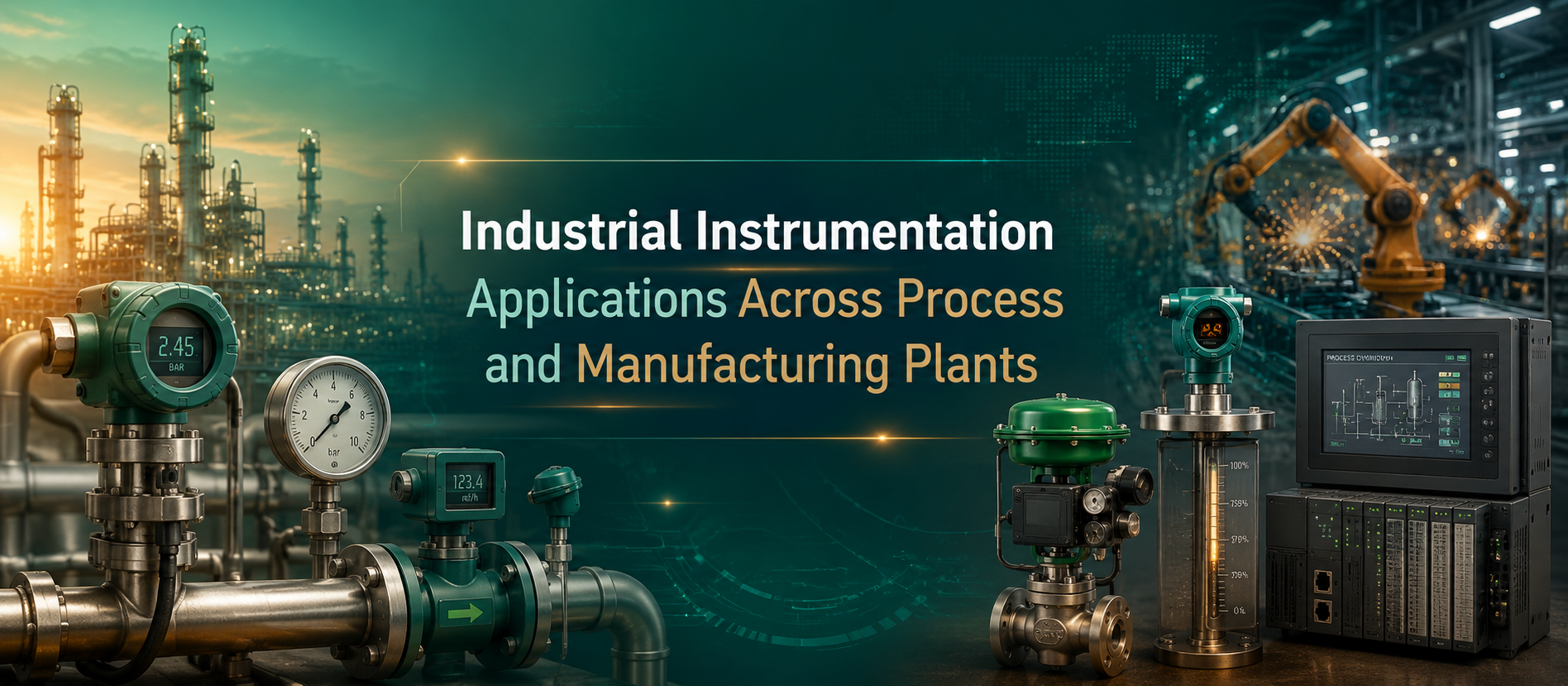
Industrial plants depend on accurate information from the field.
Before a PLC, DCS, SCADA system, or operator can make a decision, the plant first needs to know what is actually happening inside the process.
That is the role of industrial instrumentation.
From measuring pressure in a pipeline to detecting the level inside a tank or checking the temperature of a furnace, instruments provide the data required to operate industrial processes safely and consistently.
🎯 What does industrial instrumentation measure?
The most common process variables include:
Temperature
Pressure
Flow
Level
Position
Speed
Vibration
Humidity
pH
Conductivity
Weight
Density
Different industries use different combinations of these measurements.
A chemical plant may depend heavily on flow, pressure, temperature, and analytical instruments, while a packaging line may rely more on sensors for position, presence, speed, and product detection.
🌡️ Temperature measurement
Temperature affects product quality, equipment condition, chemical reactions, energy consumption, and safety.
Typical instruments include:
Thermocouples for wide temperature ranges and demanding industrial applications.
RTDs where higher measurement accuracy and stability are required.
Temperature transmitters to convert sensor signals into standardized outputs for control systems.
Applications include furnaces, boilers, reactors, ovens, heat exchangers, food processing equipment, and HVAC systems.
💨 Pressure measurement
Pressure instruments are widely used in pipelines, vessels, hydraulic systems, pneumatic systems, filters, pumps, and compressed-air networks.
Pressure transmitters can provide continuous readings to the control system, while gauges may provide local indication.
Differential pressure measurement can also help monitor filters, flow, tank level, and other process conditions.
The correct instrument depends on operating pressure, process fluid, temperature, accuracy requirement, and environmental conditions.
💧 Flow and level instrumentation
Flow measurement is important wherever liquids, gases, steam, or other process media must be monitored or controlled.
Depending on the application, plants may use magnetic, ultrasonic, vortex, Coriolis, turbine, or differential-pressure flowmeters.
Level measurement can involve:
Radar
Ultrasonic sensors
Differential pressure
Float systems
Capacitance sensors
Level switches
The process material matters significantly. Foam, vapour, dust, viscosity, tank geometry, and temperature can all affect instrument selection.
🏭 Instrumentation in manufacturing lines
Instrumentation is not limited to traditional process industries.
Discrete manufacturing plants also rely heavily on sensors and measurement devices.
Examples include:
✅ Proximity sensors for component detection ✅ Photoelectric sensors for counting and positioning ✅ Encoders for speed and position ✅ Load cells for weighing ✅ Vibration sensors for machine monitoring ✅ Vision sensors for inspection ✅ Pressure switches for pneumatic systems
These devices often become part of automated assembly, material handling, packaging, inspection, and robotic systems.
🛡️ Instrumentation also supports plant safety
Certain measurements are critical for protecting equipment and personnel.
High pressure, excessive temperature, abnormal vibration, low flow, or incorrect tank level can indicate unsafe operating conditions.
Instrumentation may therefore form part of alarm systems, shutdown logic, interlocks, and safety instrumented functions.
For critical applications, procurement teams should understand the required measurement reliability, redundancy, response time, and applicable safety requirements.
🔍 What should buyers verify?
When sourcing industrial instruments, avoid selecting equipment based only on measurement range.
Check:
Process medium
Operating and maximum conditions
Required accuracy
Connection type
Wetted material compatibility
Output signal
Communication protocol
Hazardous-area requirements
Enclosure protection
Calibration requirements
Installation conditions
Maintenance accessibility
Instrumentation performs well only when the device matches the actual process.
A technically advanced transmitter installed in the wrong location, with incompatible materials or incorrect range selection, can still produce unreliable measurements.
For procurement teams, the goal should therefore be to source instruments based on the complete application, not simply the instrument category.
Looking for industrial instrumentation suppliers or system integrators? Describe your measurement or process requirement on Sourcik to identify suitable instrumentation partners.